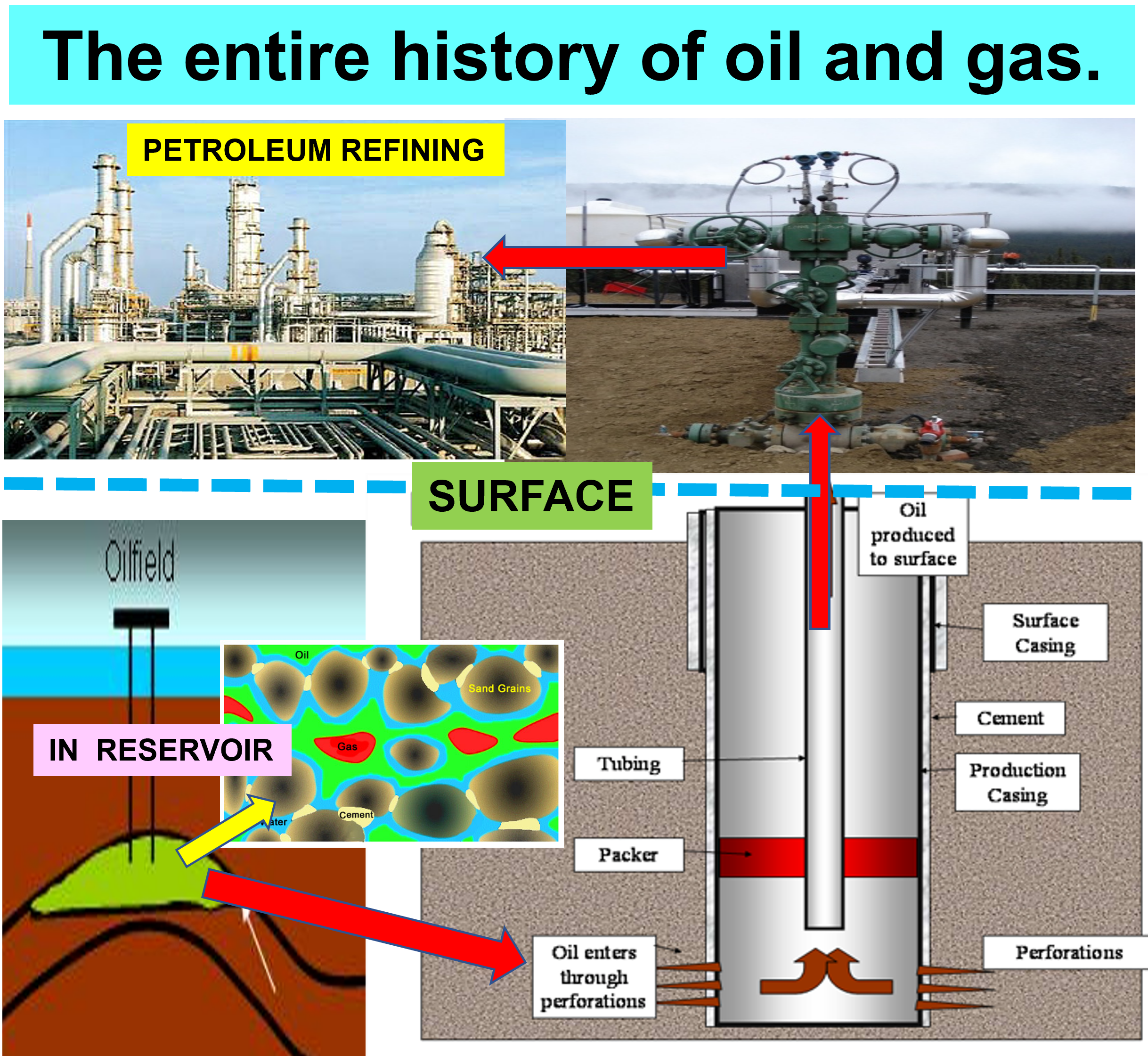
We at GSES provide solutions to problems at different phases of crude oil production from reservoir to refinery such as in drilling wells, enhanced oil recovery, demulsification, flow assurance. We design our molecular level studies to find new methods in order to achieve a better understanding of the relationship between microscopic interactions and macroscopic emulsion properties for highest possible efficiency.
Drilling Fluids
At GSES, we are engineering the future of sustainable energy exploration. Our core mission is the research and development of next-generation, environment-friendly drilling fluid components, engineering sustainable drilling chemistry.
Our dedicated R&D focuses on creating the critical elements your operation needs: stable fluid loss agents, advanced lubricants, and specialized high-temperature viscosifiers all meticulously formulated as per the requirements.
Fluid Loss Agents: We provide specialized solutions in developing starch-based fluid loss agents, designed to form thin, impermeable filter cakes. These agents are engineered to maintain their thermal stability and chemical effectiveness, even in High-Temperature, High-Pressure (HTHP) environments, preventing costly mud invasion and formation damage.
Lubricants: Our R&D helps you develop environmentally-friendly lubricants synthesized to significantly reduce the coefficient of friction between the drill string and the wellbore, mitigating torque and drag.
We provide deep technical expertise and develop customized solutions designed precisely to meet your unique operational challenges and specific drilling fluid requirements.
Let us help you drill smarter and greener.
Enhanced Oil Recovery
The composition of petroleum crudes and the mineralogy of reservoir rocks significantly influence crude oil recovery, especially during enhanced oil recovery (EOR). Current EOR screening methodologies rely on bulk petrophysical and chemical parameters, but these fail to capture the complexities of subsurface interactions. Recovery efficiency is fundamentally governed by molecular-level phenomena occurring at the interfaces of rock materials, crude oils, and injected fluids. We, based on designed experimentation and understanding of the molecular level interaction phenomenon between crude oils, reservoir rocks, injected solution (low-saline, surfactant), provide customized EOR solutions for optimized recovery from a specific hydrocarbon reservoir.
Flow Assurance
The safe and efficient delivery of hydrocarbon crude oil from reservoir to refinery is the most important component of flow assurance to minimize financial loss for oil industry. As different parameters jointly control the aggregation and network formation, it is considered that none of the available techniques can provide a clear understanding of the phenomenon and their related hazards. We try to understand the component level contribution for network building and their effect in viscosity increase vis-a-vis flow behavior during production from high temperature subsurface reservoir to low temperature surface installations and accordingly design the flow-assurance solution.
Demulsification
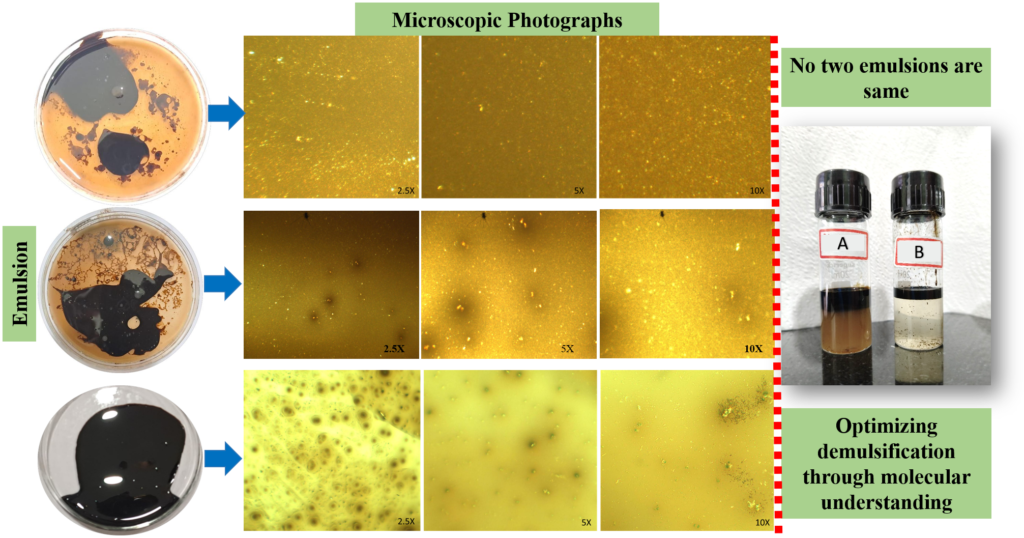
Demulsification is a persistent challenge in petroleum industries despite various separation methods. Crude oil demulsification remains difficult and inefficient, requiring long residence times. While research has advanced our understanding, further investigation is needed, particularly regarding interfacial properties and the composition. Therefore, efficient and economical emulsion breaking is crucial for maintaining crude quality. Our molecular-level study aims to elucidate the relationship between microscopic interactions and macroscopic emulsion properties for improved demulsification efficiency.