
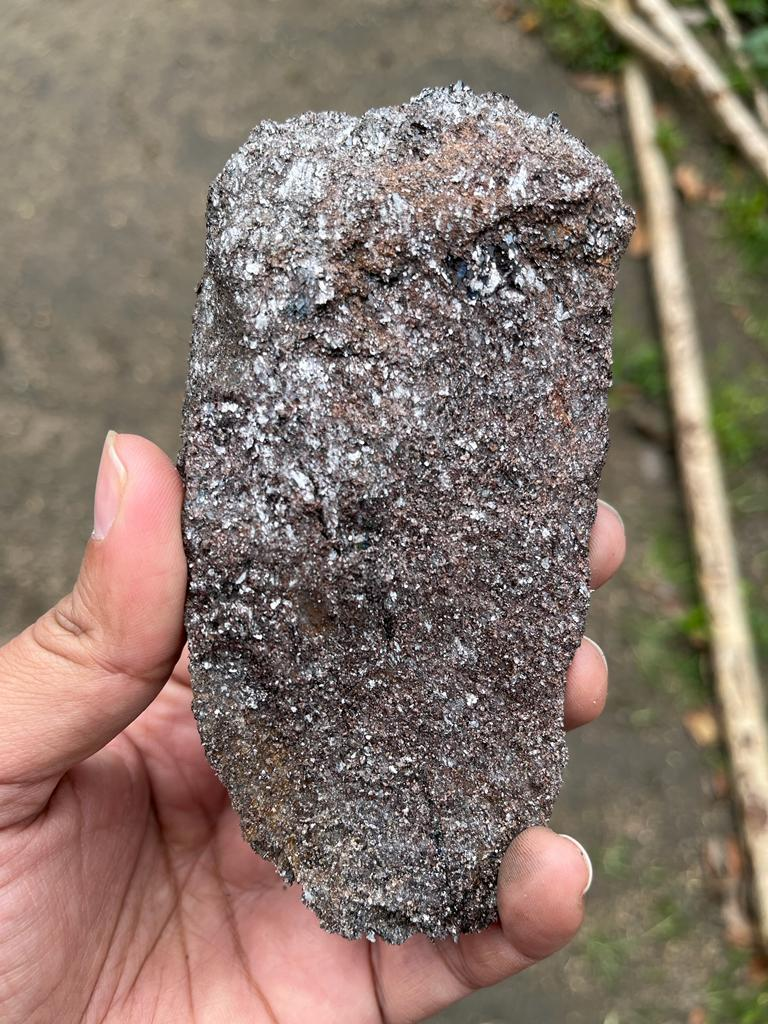
Graphite is a form of pure carbon that normally occurs as black crystal flakes and masses. Its unique physical and chemical properties make it well-suited to many industrial applications, including electronics, lubricants, metallurgy, and steel making. Consumption of smart electronic devices has caused a growth in demand and this may continue to grow as sales of electric and hybrid vehicles require larger batteries.
Graphite generally forms from high-grade metamorphism of organic matter in sediments . The three main types of commercially significant natural graphite are crystalline or disseminated flake, crystalline vein or lump, and microcrystalline or amorphous graphite. The value of graphite deposits depends on grade, purity, size and range of flakes or needles, while the presence of impurities that may have a negative effect on extraction.
Demand for natural flake graphite (NFG) has been growing steadily over the past few decades because of the demand for lithium-ion batteries, which are used in electronics such as tablets, laptops and smartphones as well as in electric cars. The battery in a fully-electric car can contain as much of 40 kg of graphite, not to mention the proliferation of mobile devices that use Li-ion batteries — so the demand for the graphite mineral is already high and will likely keep growing as the world transitions to clean energy sources.
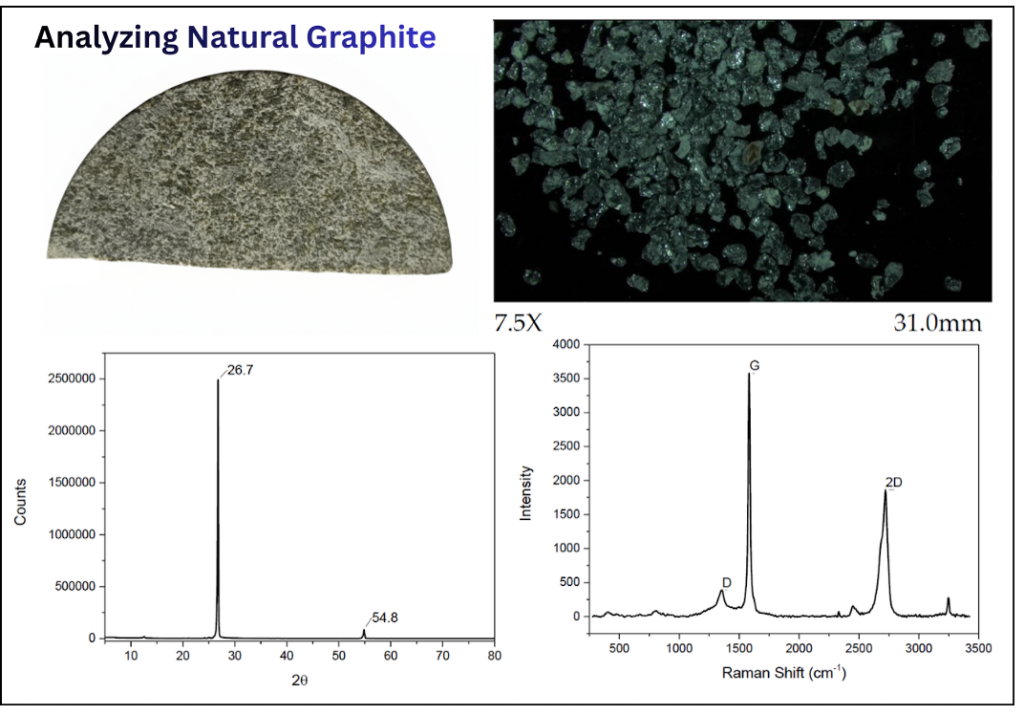
Molecular Characterization of Natural Graphite: Important knowledge for futuristic exploration and exploitation
Graphite is an allotropic form of the element carbon consisting of layers of hexagonally arranged carbon atoms in a planar condensed ring system. Graphene is a one atom layer thick carbon sheet. Graphene exhibits many interesting electronic, optical and mechanical properties due to its two-dimensional (2D) crystal structure. Graphite is the most common anode material for (metal) ion batteries. One of the main advantages of graphite against alloying anodes is that graphite has a very low volume expansion on intercalation.
Molecular Characterization of graphite samples could provide important information regarding their microstructural information and their value for industrial applications.The macromolecular structural parameters could be properly understood with XRD, Raman spectroscopy is one of the most powerful tools for the study of carbonaceous materials, especially sp2 or close to sp2 carbon materials such as graphite and other carbon materials. For understanding the detailed molecular characterization, structural properties with layer thickness, functional group, size extension, GSES would be using other characterization techniques like UV-Visible absorption spectroscopy, Fluorescence spectroscopy, FTIR spectroscopy, Scanning Electron Microscopy for futuristic applications.