
Decoding the Role of Crude Oil Chemistry in Optimizing Surfactant Flooding
Traditional recovery methods—primary and secondary waterflooding—typically leave behind 60% to 70% of a reservoir’s original oil in place. This residual oil remains immobilized by capillary forces, trapped in microscopic pore throats.
With global energy demand rising and the discovery of massive new easy fields declining, maximizing existing assets is no longer optional. Surfactant EOR is becoming a critical tool for global energy security and extending the life of mature fields. In 2026, the global surfactants for EOR market are valued at approximately $1.97 billion, with a steady growth projection toward $2.9 billion by 20361.
Surfactant flooding implies the injection of suitable surfactant either alone or in combination with co-surfactants, polymers, alkali, and nanoparticles to enhance the recovery of oil from the reservoir. The selection of surfactant is critical to achieve the desired recovery. Many factors, such as reservoir rock parameters (depth, temperature, rock type), fluid parameters (oil viscosity, gravity, composition, salinity), as well as rock-fluid and fluid-fluid interactions influence the recovery of residual oil. A single type of surfactant may not be suitable for different conditions. A clear understanding of both rock-fluid and fluid-fluid interactions is essential for selecting the optimal surfactant and maximizing oil recovery.
The Mechanism: Breaking the Capillary Barrier
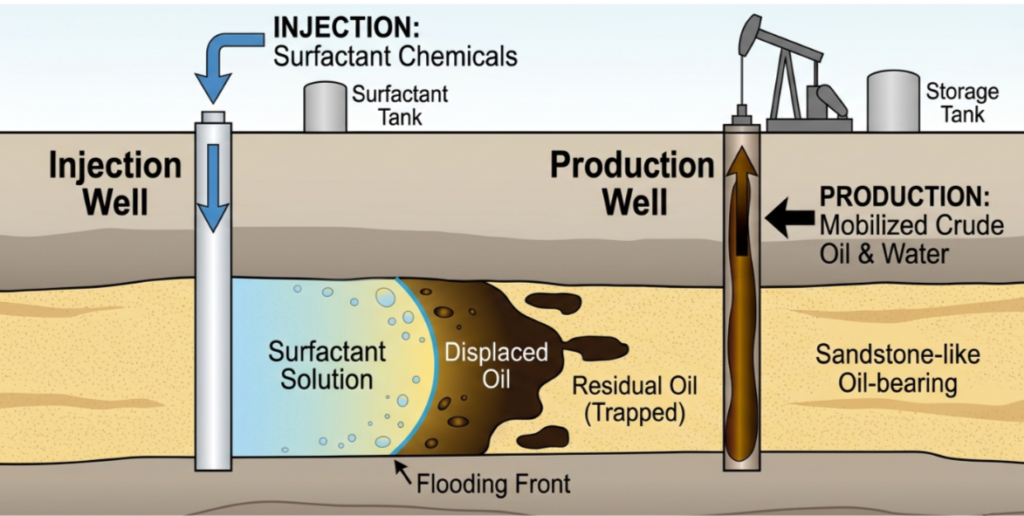
The fundamental goal of surfactant flooding is reduction of Interfacial Tension (IFT) between oil and water and wettability alteration of the reservoir system2, 3. Surfactants—amphiphilic molecules with both hydrophilic and lipophilic moieties—migrate to the interface to reduce IFT. By lowering IFT to ultra-low levels (often 10-3 mN/m), the capillary forces that hold the oil droplets are overcome. This allows the oil to flow through narrow pore constrictions and coalesce into a mobile oil bank that can be swept towards production wells3.
Parameters affecting the Selection Matrix: Dosing and Reservoir Parameters
Surfactant selection and dosing is a technical challenge dictated by the harsh thermodynamic and chemical environment of the subsurface. Key variables include:
- Salinity and Divalent Ions: The presence of salts containing calcium (Ca2+) or magnesium (Mg2+) can trigger phase separation or precipitation, making them ineffective4, 5. Every surfactant-oil system has an optimal salinity where IFT is minimized.
- Thermal Stability: In reservoirs with high-temperature environments, a surfactant must maintain its molecular integrity; if it degrades before reaching the flood front, the recovery is lost.
- Adsorption Kinetics: If the surfactant sticks to the rock surface instead of staying at the oil-water interface, the project becomes economically not viable. Molecules that exhibit high affinity for the mineral surfaces of the rock (adsorption) are removed from the flood front, reducing the efficacy of the process6.
- Role of electrostatics: The electrostatic interaction between the ionic charges of the surfactant and the polar components of the crude oil, such as asphaltenes and naphthenic acids, dictates the stability of the oil-water interface. If these charges are not strategically matched to the mineral surface of the reservoir rock, the surfactant may prematurely adsorb onto the rock or fail to achieve the ultra-low interfacial tension required for oil mobilization. Selecting a surfactant with a compatible charge is a critical prerequisite for maintaining a stable flood front and preventing significant chemical loss7.
Crude Oil Chemistry: A Significant Parameter
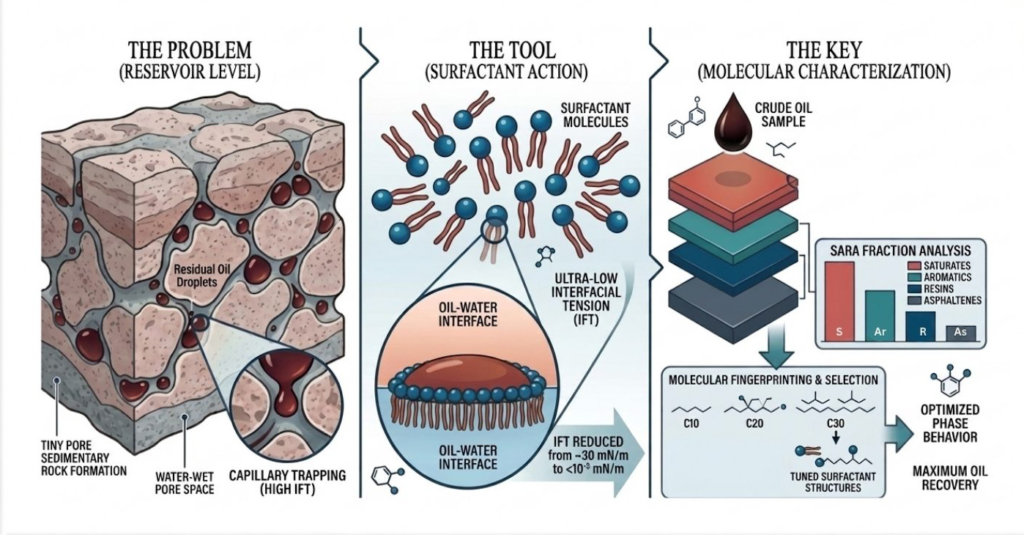
Crude oil is often treated as a simple liquid, but it is compositionally a complex mixture. The SARA fractions (Saturates, Aromatics, Resins, and Asphaltenes) govern the oil’s interaction with chemical intervention.
1. Equivalent Alkane Carbon Number (EACN): The EACN quantifies hydrophobicity of the crude oil to help optimize aqueous phase formulations for injection. A surfactant must be mathematically tuned to the specific EACN of the crude to achieve the required phase behavior 8.
2. Asphaltenes: These heavy, polar molecules can shift the reservoir’s wettability from water-wet to oil-wet. This change creates a film of oil on the rock surface that is significantly harder to displace 9.
3. Naphthenic Acids: Some crudes contain indigenous acids that react with alkaline injection fluids to create in-situ soaps 10. While this can naturally assist the process, unmanaged reactions can lead to complex emulsions that clog production equipment.
Key Determinants of EOR Efficiency
The main challenges in surfactant-assisted flooding are ensuring that surfactants remain compatible under harsh reservoir conditions and minimizing their adsorption onto rock surfaces. Additionally, the wide variety of available surfactants makes it difficult to select the most suitable one for specific reservoir conditions. The value of molecular characterization lies in its ability to provide a solution by enabling a shift from trial-and-error approaches to a mechanistic, predictive understanding of enhanced oil recovery (EOR) processes.
- Preventing Chemical Loss: Understanding polar components allows to predict and mitigate adsorption onto rock surfaces.
- Optimizing Phase Transitions: Phase behavior transitions within the Winsor classification system —the critical interplay of oil, water, and surfactant are precisely dictated by the interaction between the surfactant’s structure and the crude’s chemical constituents11.
- Economic Viability: EOR chemicals are expensive. Precise surfactant selection and minimum effective dosing ensure the project remains economically sustainable while preventing excessive chemical waste.
The future of oil recovery lies at the intersection of fluid dynamics and molecular chemistry. A profound understanding of crude oil at the molecular level is indispensable; it is integral to the roadmap for navigating the complexities of mature reservoirs and unlocking the energy potential that remains trapped beneath the surface.
References:
1. https://www.factmr.com/report/surfactants-for-enhanced-oil-recovery-eor-market
2. Sheng, J.J., 2013. Comparison of the effects of wettability alteration and IFT reduction on oil recovery in carbonate reservoirs. Asia‐Pacific Journal of Chemical Engineering, 8(1), pp.154-161.
3. Sheng, J.J., 2015. Status of surfactant EOR technology. Petroleum, 1(2), pp.97-105.
4. Tabary, R., Bazin, B., Douarche, F., Moreau, P. and Oukhemanou-Destremaut, F., 2013, March. Surfactant flooding in challenging conditions: Towards hard brines and high temperatures. In SPE Middle East Oil and Gas Show and Conference (pp. SPE-164359). SPE. Doi: https://doi.org/10.2118/ 164359-ms
5. Mohammadi, H., Delshad, M. and Pope, G.A., 2009. Mechanistic modeling of alkaline/surfactant/polymer floods. SPE Reservoir Evaluation & Engineering, 12(04), pp.518-527.
6. Kamal, M. S., Hussein, I. A. & Sultan, A. S., 2017. Review on Surfactant Flooding: Phase Behavior, Retention, IFT, and Field Applications. Energy and Fuels 31, 7701–7720.
7. Chen, W. and Schechter, D.S., 2021. Surfactant selection for enhanced oil recovery based on surfactant molecular structure in unconventional liquid reservoirs. Journal of Petroleum Science and Engineering, 196, p.107702.
8. Lemahieu, G., Ontiveros, J.F., Molinier, V. and Aubry, J.M., 2024. Exploring the impact of surfactant types and formulation variables on the EACN of crude and model oils. Colloids and Surfaces A: Physicochemical and Engineering Aspects, 694, p.134029.
9. Farajollahi, S., Bazvand, M. and Tahernejad, E., 2024. Asphaltene deposition effects on reservoir rock wettability and modification strategies. Heliyon, 10 (21).
10. Sheng, J. J. Investigation of alkaline crude oil reaction. Petroleum 1, 31–39 (2015).
11. Pal, N., Saxena, N. and Mandal, A., 2017. Phase behavior, solubilization, and phase transition of a microemulsion system stabilized by a novel surfactant synthesized from castor oil. Journal of Chemical & Engineering Data, 62(4), pp.1278-1291.