
Coal in the Future Energy System: Clean Technologies, Hydrogen Production, and Critical Mineral Recovery
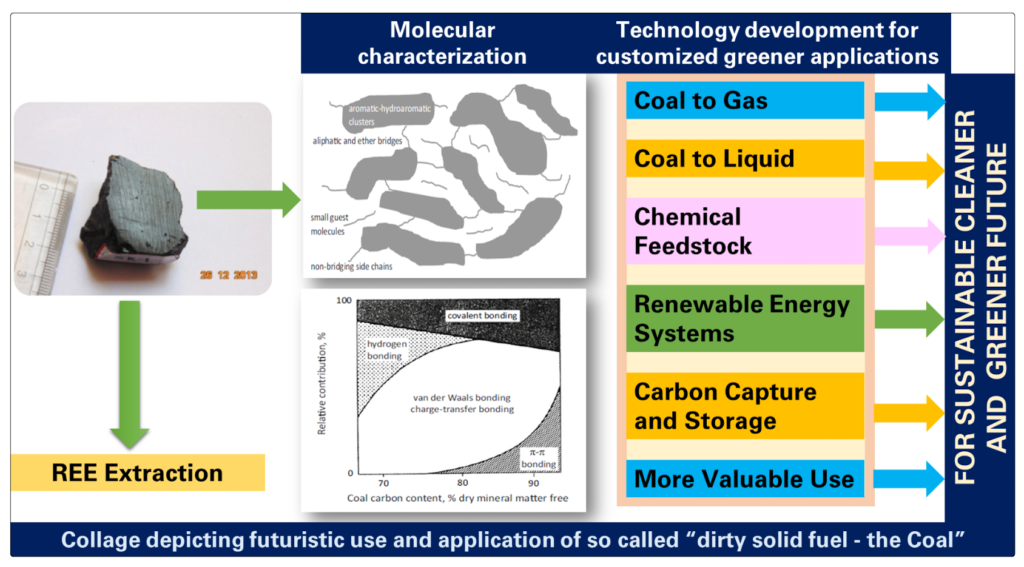
Coal is a heterogeneous natural material with a three-dimensionally cross-linked network that consists of aromatic and hydroaromatic units connected by short aliphatic and ether linkages (1, 2, 3). The arrangement of nanometer-sized polyaromatic hydrocarbons with sp2 carbon allotropes varies with increasing coal rank through coalification process with carbon content rising from 70 wt.% in lignite to 75% in sub-bituminous, 85 % in bituminous and 94 % in highest ranked anthracite coal (2,3,4). Carbon science and its immense individual applications are recognized by the research and scientific community because of their unique and fundamental properties (5). The intense demand of carbon nanomaterials in different spheres of industrial application in the present advanced civilization, vis-à-vis use of expensive carbon feedstock with more expensive synthesis methods for nanomaterials production, limits the commercialization of these methods. Recent advancements in the production of various carbon-based nanomaterials from coals of different ranks (lignite, bituminous, anthracite) as raw materials open a new vista for potential application in the energy, environment and healthcare sector. Despite the development of numerous synthesis processes and fabrication technology, the mass production of environmentally friendly carbon-based nanomaterials in low cost is a challenge.
Coal has historically been the backbone of industrial development and electricity generation worldwide. Despite the global transition toward renewable energy, coal still plays a critical role in energy security, especially in rapidly developing economies. In countries such as India, coal contributes a major share of electricity generation due to its availability, affordability, and high energy density. However, traditional coal utilization is associated with significant environmental challenges, particularly greenhouse gas emissions.
Although its widespread use as a fossil fuel and raw material has helped advance the economy of many countries across the globe, rising concerns for the environment have significantly curbed its production and use, especially in developed countries. India ranks 2nd globally when it comes to the consumption of coal. At present, coal accounts for 55% of the energy needs in India, although the overall energy demand is expected to rise significantly due to the increasing population, expanding economy, and a quest for improved quality of life.
The increasing demand for clean energy with minimum environmental impact is driving the need for the development of efficient energy conversion technologies with efficient storage systems and production of advanced materials for future valuable use. Coal, being an abundant and cheap feedstock of carbon and carbon-based materials, could provide a feasible and long-term solution in energy, environment, and societal applications.
Coal will continue to occupy the center stage of India’s energy scenario. Molecular distributions, molecular architecture vis-à-vis rank of coal has a tremendous significance in determining the quality and suitability for specific applications such as feed-stock for chemicals, synthetic fuels, advanced carbon nano-material and in energy storage. Preliminary characterization of Indian coals has demonstrated the presence of nano-sized poly-cyclic-aromatic hydrocarbon (PAHs) for various potential applications, while the inter-layered spacing of the disordered carbon nano sheets present in coals and their electro-chemical behavior highlighted the potentiality of Indian coals to be used in energy storage applications, i.e., in lithium-ion and sodium-ion batteries. Despite this fact, it is potentiality for generating clean fuel like Hydrogen and producing fuel cells, super capacitors and futuristic nano-materials are being critically experimented on and hold the possibility of developing a successful and optimistic market.
To address these concerns, research and technological innovation are transforming coal from a conventional fuel into a cleaner and more efficient energy resource. Emerging technologies such as coal gasification, carbon capture and storage (CCS), underground coal gasification (UCG), and coal-to-chemicals processes are redefining the role of coal in a sustainable energy future.
The Global Importance of Coal
Coal remains one of the most abundant fossil fuels on Earth. Its advantages include:
• Large global reserves ensuring long-term availability
• Stable and reliable energy supply
• Lower cost compared to oil and natural gas
• Critical role in electricity generation, steel production, and cement manufacturing
However, conventional coal combustion produces large amounts of carbon dioxide (CO₂), sulfur oxides, nitrogen oxides, and particulate matter, making cleaner technologies essential for its continued use.
Clean Coal Technologies for a Low-Carbon Future
Coal will still be used globally and is no longer viewed only as a fuel. Converting Coal into Clean Energy and Chemicals for energy security and chemical industries. Modern processes enable it to produce valuable energy carriers and chemicals. So cleaner coal technology is a major research area and the focus on technologies that reduce emissions while continuing coal use.
• Carbon Capture and Storage
• Integrated Gasification Combined Cycle
• Ultra-supercritical coal power plants
• Carbon utilization technologies
Major Products from Coal Conversion
Product | Application |
Hydrogen | Clean energy, fuel cells |
Synthetic Natural Gas | Power generation |
Liquid fuels | Diesel, gasoline substitutes |
Ammonia | Fertilizer production |
Methanol | Chemical industry |
Coal as a Source of Critical Minerals and Rare Earth Elements
Coal deposits may become future sources of critical materials. Coal and coal (fly) ash contain valuable elements like Rare Earth Elements, critical and strategic minerals, which are important for electronics and renewable energy.
Coal-to-Hydrogen
Coal-to-hydrogen is a Transitional Pathway for the Hydrogen Economy and environmental remediation. In the scenario of energy transition, traditional coal resources could be linked with future clean fuel systems. Coal can produce hydrogen using gasification (Hydrogen Economy) and carbon capture for both green energy generation and environmental remediation.
Advanced Materials from Coal
Coal can be used to produce high-value carbon materials. Advanced carbon materials, comprising graphene, fullerenes, carbon fibers, activated carbon, carbon nanotubes are considered as the backbone of material science and technological innovation for future sustainable development. Carbon nanomaterials have huge potential in the application of biology, medicine, electronics, energy technologies and drug delivery. Many of the allotropes of carbon materials have shown promising results in renewable energy resource and in energy storage application. Carbon-nanotubes (CNT) and graphene exhibit extraordinary mechanical strength and electrical conductivity with remarkable physical and chemical properties, which are suitable perfectly in the application like catalysis, biosensors, fuel cells, batteries and electronic devices (6,7,8,9,10,11). Carbon dots (CD’s) and graphene quantum dots (GQDs), due to their attractive properties like chemical inertness, tunable photoluminescence, non-toxicity and excellent bio-compatibility, are applicable in areas like photovoltaics, optical sensing, bio-imaging, and drug delivery (12, 13).
Coal will continue to play an important role in the global energy mix for several decades, particularly in developing economies. However, its future lies in technological transformation rather than traditional combustion.
Key trends shaping the future of coal include:
• Integration with carbon capture and storage
• Expansion of coal gasification and hydrogen production
• Development of underground coal gasification
• Conversion of coal to chemicals and synthetic fuels
• Integration with renewable energy systems
Coal has powered industrial development for centuries, but its future depends on technological innovation and environmental responsibility. These innovations will determine whether coal can transition from a high-emission fuel to a strategic resource for sustainable energy and materials. Advanced processes such as gasification, CCS, and underground coal conversion offer pathways to reduce emissions while maintaining energy security.
The concept of “Coal for the Future” therefore does not mean increased coal consumption, but rather smarter, cleaner, and more efficient utilization of this abundant resource. With proper research, policy support, and technological deployment, coal can play a transitional role in achieving a balanced global energy system.
References
- R. Ye, C. Xiang, J. Lin, Z. Peng, K. Huang, Z. Yan, N.P. Cook, E.L. Samuel, C.C. Hwang, G. Ruan, G. Ceriotti, A.R. Raji, A.A. Marti, J.M. Tour, Coal as an abundant source of graphene quantum dots, Nat. Commun. 4 (2013) 2943.
- M.W. Haenel, Recent progress in coal structure research, Fuel 71 (1992) 1211–1222.
- S. Vasireddy, B. Morreale, A. Cugini, C. Song, J.J. Spivey, Clean liquid fuels from direct coal liquefaction: chemistry, catalysis, technological status and challenges, Energy Environ. Sci. 4 (2011) 311–34520,26,27.
- J.P. Mathews, A.L. Chaffee, The molecular representations of coal – a review, Fuel 96 (2012) 1–14.
- Nasir, S., Hussein, M. Z., Zainal, Z., & Yusof, N. A. (2018). Carbon-based nanomaterials/allotropes: A glimpse of their synthesis, properties and some applications. Materials, 11(2), 295.
- K. Moothi, S.E. Iyuke, M. Meyyappan, R. Falcon, Coal as a carbon source for carbon nanotube synthesis, Carbon 50 (2012) 2679–2690.
- Q. Cao, J.A. Rogers, Ultrathin films of single-walled carbon nanotubes for electronics and sensors: a review of fundamental and applied aspects, Adv. Mater. 21 (2009) 29–53.
- J. Deng, Y. You, V. Sahajwalla, R.K. Joshi, Transforming waste into carbon-based nanomaterials, Carbon 96 (2016) 105–115.
- Y. Zhu, S. Murali, W. Cai, X. Li, J.W. Suk, J.R. Potts, R.S. Ruoff, Graphene and graphene oxide: synthesis, properties, and applications, Adv. Mater. 22 (2010) 3906–3924.
- H. Xu, Q. Lin, T. Zhou, T. Chen, S. Lin, S. Dong, Facile preparation of graphene nanosheets by pyrolysis of coal-tar pitch with the presence of aluminum, J. Anal. Appl. Pyrol. 110 (2014) 481–485.
- P. Avouris, C. Dimitrakopoulos, Graphene: synthesis and applications, Mater. Today 15 (2012) 86–97).
- Van Chinh Hoang, Mahbub Hassan, Vincent G. Gomes 2018. Coal derived carbon nanomaterials – Recent advances in synthesis and applications, Applied Materials Today, V 12, 2018, 342-358.
- Aneeqa Bashir, Azka Mehvish and Maria Khalil. Advanced Carbon Materials for Sustainable and Emerging Applications DOI: http://dx.doi.org/10.5772/intechopen.100213