Breaking the Film: The role of molecular understanding of crude petroleum in demulsification
Breaking the Film: Molecular Insights into Crude Oil Demulsification
Petroleum crude is a mixture of mainly hydrocarbons (saturates and aromatics), along with organic compounds containing heteroatoms – nitrogen, sulphur, oxygen (resin and asphaltenes) – and trace metallic elements (often found in porphyrins). Composition of crude oil is a chemical continuum, with gradual increase in molar mass and polarity from saturates to aromatics, to resins, and asphaltenes. The presently accepted model of crude oil depicts that asphaltene molecules are surrounded by the polar ends of resins, whereas the paraffinic end components of the resin molecules act as a tail making the transition to the relatively nonpolar bulk of the oil, which contains the aromatic and saturate components (Hammami et al., 2000, Hammami et al., 1998, Haskett, et al.,1965).
Emulsion Formation and Stabilization Mechanisms
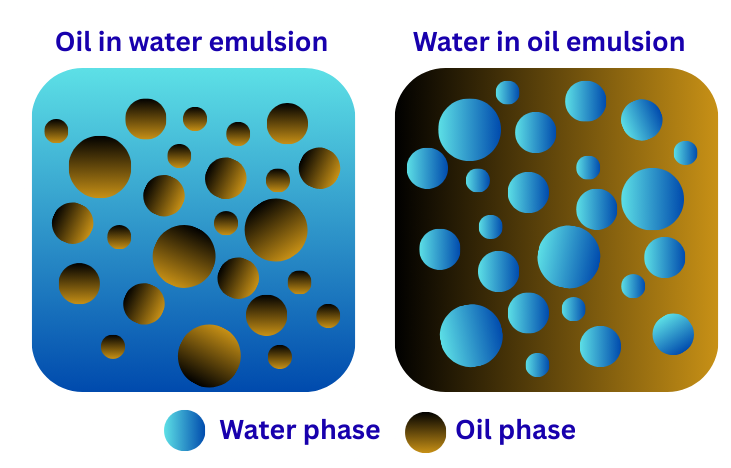
Crude oil production and processing frequently involve the formation of emulsions, either oil-in-water (O/W) or water-in-oil (W/O) emulsions. Asphaltenes and resins– the crude oil components that act as the natural surfactants, along with natural nanoparticles like silica and clay, are the principal components responsible for emulsion stabilization.
These emulsions are typically stabilized through three primary mechanisms:
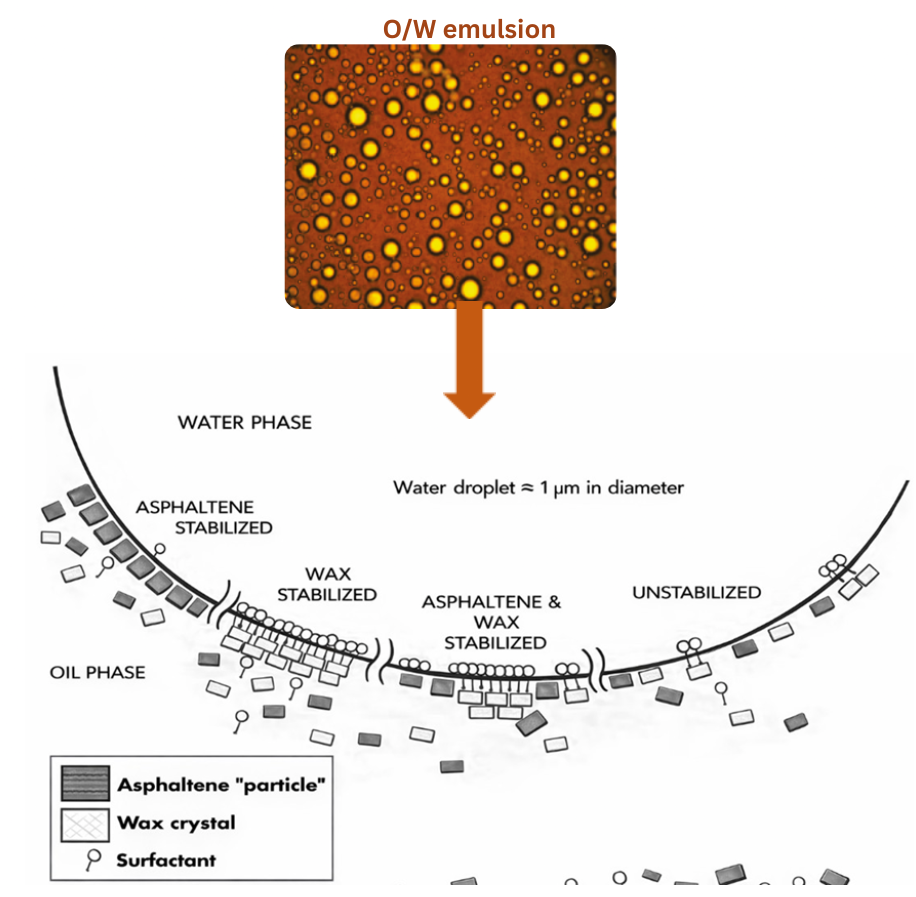
(i) Interfacial film formation: Adsorbed asphaltenes create a mechanically strong film at the oil–water interface. The film exhibits high interfacial shear viscosity, reduced interfacial tension, and provides steric hindrance. The rigidity of this film is governed by molecular packing density and intermolecular interactions.
(ii) Electrostatic interactions: Ionizable functional groups (–COOH, –OH, –NH) at the interface contribute to surface charge development. Electrical double layer formation around water droplets enhances repulsive forces, thereby increasing emulsion stability.
(iii) Hydrogen bonding networks: Water droplets interact with polar crude components through hydrogen bonding, strengthening the interfacial layer and inhibiting droplet coalescence.
Types of emulsion
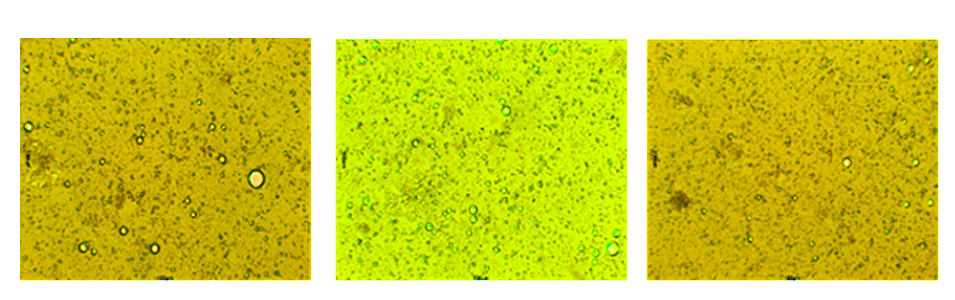
Photomicrographs of untreated emulsion (water-in-oil emulsion) under polarized microscope
Challenges and Methods of Demulsification
These emulsions increase viscosity, cause corrosion, reduce crude oil quality and refining efficiency, and elevate transportation costs. Several methods of demulsification have been tried and proposed for industrial practice and application. These include (1) Thermal 2) Chemical 3) Mechanical 4) Electrical and 5) Electromagnetic methods. However, separating water-in-oil (W/O) emulsions in heavy crude can be exceptionally difficult and inefficient, often failing to reduce water content below permissible limits. Such highly viscous emulsions incur significant costs across the refinery system due to equipment damage and disposal challenges.
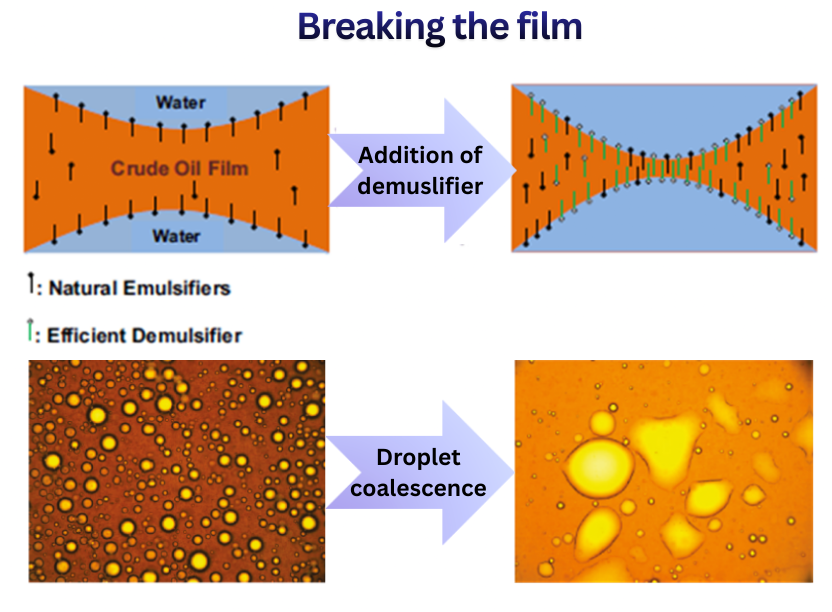
Effective demulsification—separation of water from crude oil—requires a detailed molecular understanding of interfacial phenomena, colloidal stability, and chemical interactions among crude oil components, water, and added demulsifiers. Demulsification includes two steps: first, the aggregation, flocculation or coagulation of droplets must occur; and second, these aggregated droplets must coalesce. Successful separation occurs when the interfacial film surrounding the water droplets is ruptured, allowing for coalescence and the subsequent gravitational settling of the water phase.
Stabilization of water in oil emulsion by asphaltenes+wax+surfactants. (Source: Lee 1999)
Schematic image of interfacial film thinning process between two droplets in water in crude oil emulsion after the addition of an efficient chemical demulsifier.
Molecular-Level Mechanisms
Effective demulsification relies on the following molecular interventions:
(i) Hydrogen bonding disruption
(ii) π–π stacking breakdown
(iii) Reduction in interfacial viscoelasticity
(iv) Enhanced droplet collision efficiency.
Rationale and Critical Design Parameters of Next-Gen Demuslifiers
Rational Design of Next-Generation Demulsifiers Future demulsifier development should focus on four key areas:
(i) Tailored block copolymers with tunable HLB
(ii) Stimuli-responsive polymers
(iii) Nanoparticle-assisted demulsification
(iv) Green bio-based surfactants
Critical Design Parameters For a demulsifier to be commercially viable, it must meet these specific criteria:
(i) Optimal polarity matching
(ii) Controlled molecular architecture
(iii) interfacial elasticity reduction capability
(iv) Thermal and salinity tolerance.
References
Hammami, A., Phelps, C.H., Monger-McClure, T. and Little, T.M., 2000. Asphaltene precipitation from live oils: An experimental investigation of onset conditions and reversibility. Energy & Fuels, 14(1), pp.14-18.
Hammami, A., Ferworn, K.A., Nighswander, J.A., Over˚, S.V.E.R.R.E. and Stange, E., 1998. Asphaltenic crude oil characterization: An experimental investigation of the effect of resins on the stability of asphaltenes. Petroleum science and technology, 16(3-4), pp.227-249.
Haskett, C.E. and Tartera, M., 1965. A practical solution to the problem of asphaltene deposits-Hassi Messaoud Field, Algeria. Journal of petroleum technology, 17(04), pp.387-391.
Lee, R.F., 1999. Agents which promote and stabilize water-in-oil emulsions. Spill Science & Technology Bulletin, 5(2), pp.117-126.